
A receipt's path: from CONFIRM to EOR
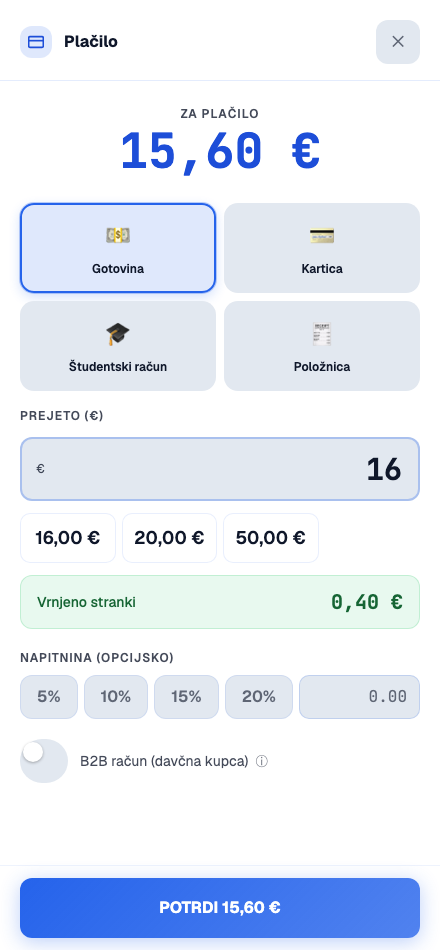
- The cashier presses CONFIRM. The till sends the order and the payment method to the server.
- The server assigns the receipt number. It is made up of the business premises identifier, the device identifier and a sequential number that runs within the calendar year.
- The server computes the ZOI, the issuer's protective mark. It signs it with your tax certificate over the tax number, the time of issue, the receipt number, the premises identifier, the device identifier and the receipt amount.
- The time of issue is frozen. The same string goes into the ZOI, onto the printed receipt and into the message to FURS, so an inspector can recompute the ZOI from paper.
- The server sends the signed message to FURS. FURS returns the EOR, the receipt's unique identifier.
- The receipt prints with the ZOI, the EOR and a QR code. The guest can use that code to verify the receipt with FURS.
So the till does not confirm anything with FURS itself. The server signs, because that is where your tax certificate sits — and no till ever holds it.
What is on the receipt and what it is for
- The ZOI is your signature. It proves the receipt was issued by your till with your certificate, and it exists before FURS answers anything.
- The EOR is FURS's answer. It proves FURS accepted the receipt and recorded it.
- The QR code is both of those written out in digits: the ZOI, the issuer's tax number, the time of issue and a check digit. The guest scans it and verifies the receipt with FURS.
What happens when FURS does not answer
The receipt is issued. It carries a number and a ZOI, and in place of the EOR it says the receipt is being processed — which is a state, not an error. The server retries every five minutes and marks the resubmission as subsequent, so FURS does not treat it as a new receipt.
The deadline for a subsequent submission is two working days. No intervention is needed: until the EOR arrives the screen does not claim the receipt is fiscalized, and once FURS answers the EOR is added automatically.
No connection: why a receipt cannot be issued
The protective mark is signed by the server with your certificate. With no connection there is therefore no mark and no receipt number, so there is no receipt either — and that is not a shortcoming of the setup but a consequence of where the certificate sits.
The sale is still accepted and fiscalizes itself once the connection returns, carrying the time of the sale rather than the time the connection came back. During the outage the guest gets a slip from the bound receipt book, and the cashier enters the slip number against the sale waiting in the queue. Cash works during an outage; card and deferred payment do not.
The X-report and the Z-report
The X-report is an interim view of turnover during a shift. It does not close the shift, so you print it whenever and as often as you like. A manager can also read it for another till's open shift, to see the expected cash before the cashier goes home.
The Z-report closes the shift. It compares expected cash against the counted amount, records the shortfall or the surplus, and gathers turnover by payment method and by VAT rate. The cashier closes it on the till they worked on.
Turnover for the day and turnover since the shift opened are not the same thing, so the printed statement names both scopes separately. Past midnight they diverge: the day has turned over while the shift is still running.
Voids and credit notes
A fiscalized receipt cannot be deleted. A void is a separate fiscal document with negative amounts, with its own number and its own ZOI, which references the original receipt. The document carries the words STORNO RAČUNA and the original receipt number.
A reason is mandatory, and a cashier or waiter can issue a void too, not only the owner. A cash void works even without a payment terminal.
What has to be in place before the till can fiscalize
A tax certificate under your own tax number and registered business premises. FURS issues the certificate to the taxpayer's tax number, so nobody can collect it on your behalf. If the premises are already registered with FURS, you copy the existing identifier across and do not file a new registration.
The full list is on the page Opening a venue: what do I need for a till →
Frequently asked questions
What are the ZOI and the EOR — and who creates them?
The ZOI is the issuer's protective mark and it is created on our side: the server signs it with your tax certificate when the receipt is issued. The EOR is the receipt's unique identifier and FURS returns it once it accepts the receipt. So the ZOI exists before FURS answers, and the EOR only afterwards.
What is in the QR code on the receipt?
Sixty digits: the ZOI converted to decimal, the issuer's tax number, the time the receipt was issued, and a check digit. There is no link to our server in the code, so the guest verifies the receipt directly with FURS.
What does it mean if the receipt has a ZOI but no EOR?
The receipt is issued and FURS has not answered yet. The server retries every five minutes and marks the resubmission as subsequent, so FURS does not receive a new receipt. The deadline for a subsequent submission is two working days, and no manual step is needed.
Can I issue a receipt without internet?
No, and that is not a matter of configuration: the protective mark is signed by the server with your certificate, so with no connection there is neither a mark nor a receipt number. The till still accepts the sale and fiscalizes it itself once the connection returns, while during the outage the guest gets a slip from the bound receipt book.
What are the X-report and the Z-report for?
The X-report is an interim view of turnover that does not close the shift, so you print it whenever you like. The Z-report closes the shift: it compares expected cash against the counted amount and gathers turnover by payment method and by VAT rate.
How do you correct a fiscalized receipt?
With a void. A fiscalized receipt cannot be deleted; a void is a separate fiscal document with negative amounts, with its own number and its own ZOI, referencing the original. A reason is mandatory, and the document carries the words STORNO RAČUNA.